Big tech, AI, and the quest for a climate-resilient power grid
By Vito Dellerba Fri, Nov 6, 2026
The power grid is not just background infrastructure. Critical systems that underpin our daily lives depend on it.
Hospitals, water systems, communications, and financial systems increasingly rely on the grid. So, now, as artificial intelligence (AI) computing demand, broad electrification and industrial reinvestment increases, these systems are facing a new kind of pressure. The grid was not built for this AI-driven surge in electricity demand colliding with the growing physical impacts of climate change.
Instead, the public often views grid regulation and upgrades as the purview of utility companies. These upgrades are often financed through rate cases, where utility companies are mandated to seek approval from regulatory bodies to approve rate changes. Ultimately, the grid has historically been supported by sovereign balance sheets through these rate-base and cost-of-service models, backstopped by the state’s ability to guarantee returns for capital investment.
That model delivered decades of serviceable but persistently underfunded infrastructure. This was due to flat demand that reduced the urgency and political appetite for capital investment and rate increases.
The question is whether the same technology companies driving that surge can also become the credit anchors needed to finance a more climate-resilient grid. Absent that coordination, there is a risk that the system quietly splits in two. Whether that split deepens depends on whether utilities, regulators, hyperscalers, and capital providers plan the grid as one system rather than as separate silos. On one side, there will be a stressed grid and on the other a growing archipelago of behind-the-meter enclaves.
The systemic risks and opportunities
Resilience investments create broad social benefits. They can avoid excess deaths, hospital surges, and business shutdowns. Those benefits are difficult to translate into bankable project revenues, but the gap is measurable. Indeed, Berkeley Lab’s 2018 report estimated annual sustained-interruption costs at about $44 billion per year with 70 percent of those costs accruing to commercial customers.
Another study estimated major-outage costs at roughly $67 billion per year over the past seven years. When resilience is valuable but hard to price, it creates a persistent risk of underinvestment. This matters at scale. The IEA estimating that global grid investment must nearly double by 2030 to more than $600 billion per year, after a decade of stagnation, just as electrification and climate volatility accelerate.
AI raises the stakes. Global data center electricity consumption is projected to more than double from about 415 terawatt-hours (TWh) in 2024 to 945 TWh by 2030. In the United States, data centers drove a 22 percent increase in electricity demand in 2025. This could triple by 2030, making them one of the largest sources of load growth. Put simply, the digital economy is moving faster than the grid was built to handle.
That convergence also creates an opening. Hyperscalers are the cloud service providers that build and operate massive data centers, including companies like Amazon Web Services, Google Cloud, and Meta. These hyperscalers, however, can also serve as credit anchors for climate-resilient grid modernization. Hyperscalers are distinctive not because they need reliable power—as every industrial user does—but because grid instability can damage sensitive chips and each megawatt of compute earns far more revenue than most industrial loads.
This is a rare alignment of interests.
Returns on grid investments
A resilient grid delivers both public benefits and private value for hyperscalers, whose speed to power and social license to operate increasingly depend on it.
Recent contracts show how that demand is already reshaping power markets. AES signed a 20-year power purchase agreement (PPA) with Google; TotalEnergies announced that it would provide one gigawatt of solar capacity to power Google’s Texas data centers; and TotalEnergies’ evolving strategy, now described as “Clean Firm Power” contracts, goes beyond standard renewable PPAs by pairing intermittent renewables with battery storage and flexible backup capacity to guarantee reliability. That reflects the non-negotiable uptime requirements of AI-driven data centers.
This matters because long-term, investment-grade demand can do more than purchase electrons. It can help finance infrastructure. If a hyperscaler’s revenue depends on uptime, then transmission resilience, firm capacity, storage, and grid hardening stop looking like externalities from the hyperscaler’s contracting perspective. Instead, they look like investable necessities. Big tech has not suddenly become altruistic. Rather, commercial incentives are beginning to line up with resilience investment.
Google’s 2025 Capacity Commitment Framework (CCF) has become an important market reference point. It leverages a pay-as-you-grow model to serve new data centers. However, not every hyperscaler is taking this route: Roughly 30 percent of planned US data-center capacity sits behind the meter, bypassing the public grid altogether. That approach may accelerate the time it takes to receive operational electricity, but it also narrows the systemic resilience benefits. It also risks entrenching a system in which the short-term economics are extremely attractive, but the long-term costs are not. Behind-the-meter generation gives hyperscalers faster, more reliable power today, but it removes a creditworthy funding partner from the shared grid and leaves remaining ratepayers to carry the long-term cost.
The core barrier is coordination
The core barrier is coordination. Hyperscalers, utilities, regulators, and long-term capital providers traditionally sit in different rooms and base rewards on different metrics. The hardest work is governance and system design.
However, there are two policy priorities that can translate this necessary alignment into built infrastructure: make large users fund grid upgrades before demand spikes further and put performance-based reliability commitments tied to specific extreme-weather events in the PPAs.
Costs should track benefits and not force non-beneficiaries to pay. In this vein, the Federal Energy Regulatory Commission (FERC) ordered PJM Interconnection, the nation’s largest grid operator, to create new transmission service options. This new approach requires co-located data center loads to pay for both the grid upgrades and ancillary services they cause and benefit from.
The White House’s Ratepayer Protection Pledge makes the same concept concrete at the highest political level. Amazon, Google, Meta, Microsoft, OpenAI, Oracle, and xAI committed to building, bringing, or buying new generation resources. Further, they committed to covering the full cost of all power delivery infrastructure serving their facilities whether they ultimately used that power or not. Google’s CCF, adopted in early 2025, anticipated the cost-causation principle the White House’s Ratepayer Protection Pledge later formalized in March 2026. The pledge is, however, voluntary and lacks binding enforcement or independent auditing. These are gaps that regulation will need to close if the commitment is to translate into durable cost-causation.
How policies can reimagine grid resilience
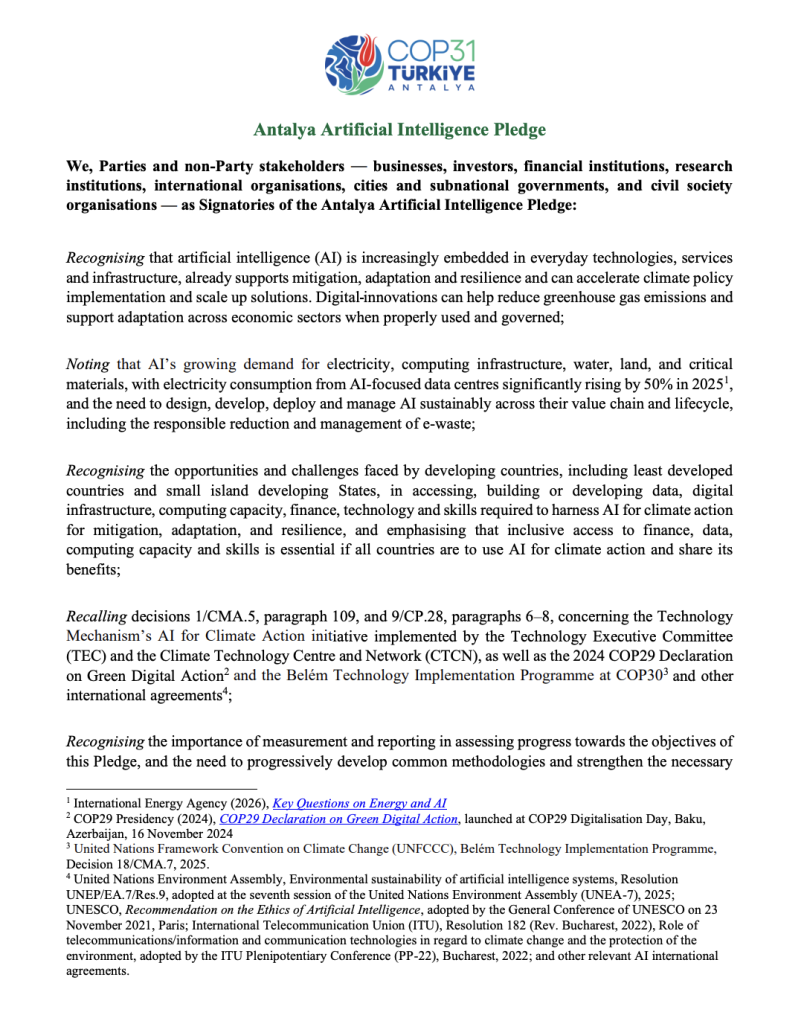
This issue will become even more prevalent in the coming weeks as the thirty first UN Conference of the Parties (COP31) just put AI on its agenda. The Antalya Artificial Intelligence Pledge invites countries and business to voluntarily commit to a “shared ambition to make AI part of the climate solution.”
The pledge positions AI as a resource in the fight against climate change, while acknowledging the burden it places on the environment and systems in which it operates. It notes that electricity consumption from AI-focused data centers rose 50 percent in 2025 alone. But the conversation must reimagine how policymakers can address this tension.
Today’s project-by-project participant funding model cannot match the speed and scale of AI-driven demand. Policymakers must assess AI-load scenarios alongside the climate stressors. They must enable and mandate systemic changes to avoid blackouts and other dangers that can put people’s health at risk.
Large-load contracts already cover reliability, curtailment, and delivery obligations. However, they seldom set performance standards for defined extreme-weather events, so climate resilience goes unpriced.
There is an emerging evolution of hyperscaler procurement toward integrated “Clean Firm Power” contracts like those championed by TotalEnergies. They bundle renewable generation, battery storage, and flexible backup capacity into a single offering designed to meet increasing demand. These contracts internalize continuous availability rather than relying on grid resilience as an implicit backstop.
The logical next step is to extend this principle from reliability to resilience. Large-load contracts should include performance standards for defined extreme-weather events. That would create the contractual basis for the resilience investment that must follow. If resilience is not written into the contract, it is not priced; if it is not priced, it will be undersupplied relative to its social value.
A new policy must build the mechanisms that allow system-level value to be financed before the next cascading grid failure forces the issue.
That will require better system-wide planning. Utilities, which build the grid assets, must plan alongside hyperscalers, grid operators, regulators, state commissions, and long-term capital providers around a shared framework anchored in speed to power, cost efficiency, social license, and system resilience. If they do, hyperscalers could help move the power system from strain to solution. If they do not, the AI boom may deepen grid vulnerabilities. It can exacerbate the lack of reliable, climate-hardened power that it depends on precisely when the cost of those vulnerabilities is highest.
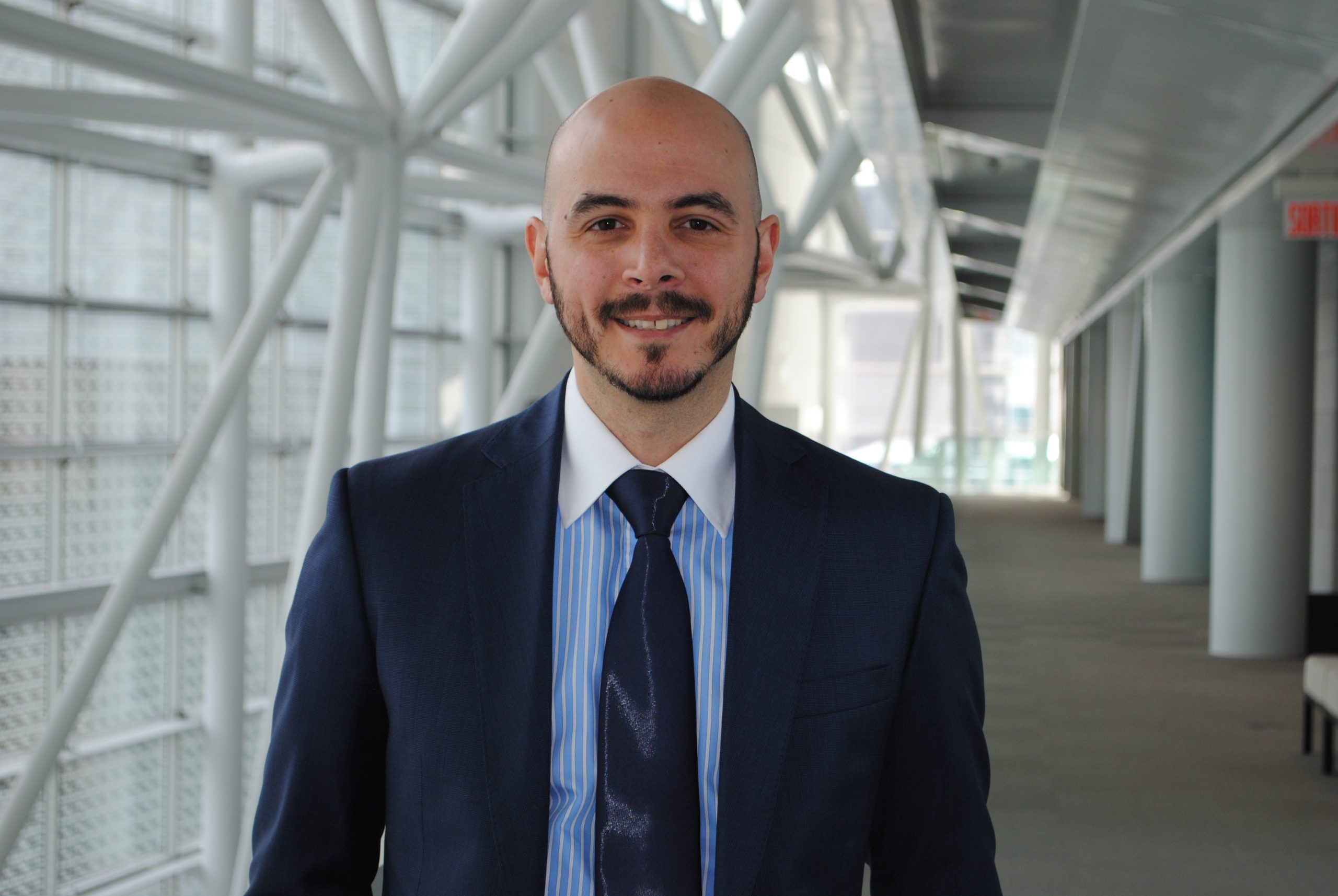
Vito Dellerba is a nonresident fellow for the Atlantic Council’s Climate Resilience Center. He serves as senior director of infrastructure financing for La Caisse and focuses on the execution of high-impact sustainable infrastructure investments.